Wednesday, January 26, 2011

Active, Passive & Portfolio Income

Do you talk to your kids about the three kinds of income? Do you know that there are three kinds: active, passive and portfolio? If the language seems a bit strange, take heart, you probably know what these words mean already and, guess what, your kids can figure them out pretty quickly too!

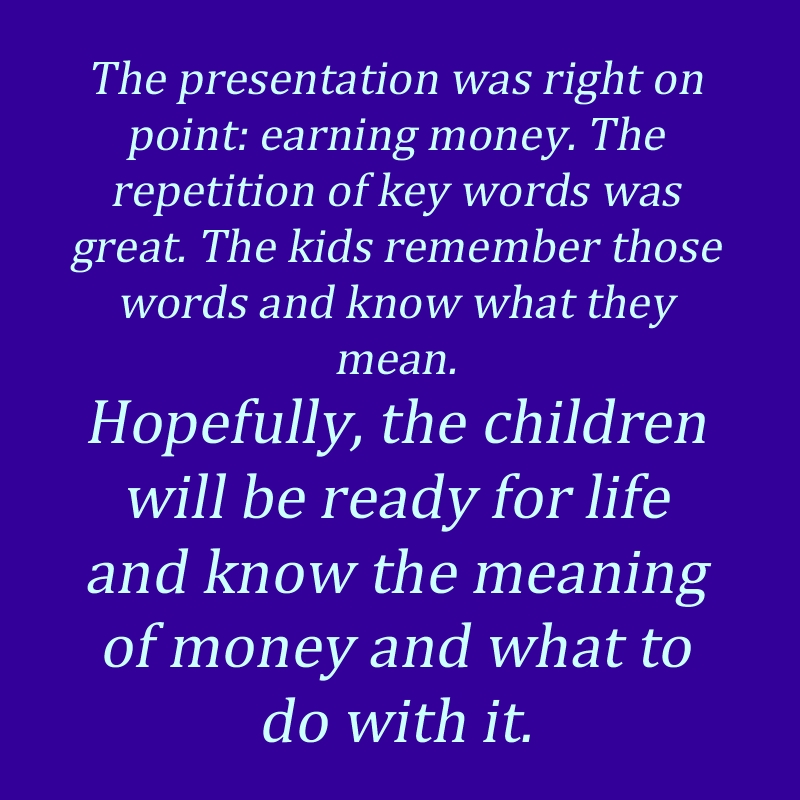
Agent Story Money & Me Workshop
This week I had the privilege of doing a one-hour Money & Me workshop on the topic of earning money with a split-class of 23 students in grades one and two.

(In my school-wide assembly shows I cover earning, spending, growing and sharing your money. But for the grade-specific classroom workshops I ask the teacher to choose one of those four topics.)

My goal was to introduce these youngsters to the idea that there are three ways to earn money: active income, passive income and portfolio income. And with the help of a take-home craft and a memorable story about three little ferrets who have to figure out how to earn money to put in their pockets, I'm hoping that at least one of the kids will bring up the topic of income at the dinner table. "Hey, Mom, do you have any portfolio income?" Wouldn't that be cool?

Now if you are not entirely familiar with the terminology, here's your cheat sheet.

Active Income
Think about what "active" means. It means moving, doing, being in action. When you earn money by working (either for yourself or someone else) that is what we call active income. You are working and you get paid. In a child's world, allowance is active income. Me do chores, me get paid.

Passive Income
It's really almost the opposite of active income. If you rent out a room in your house to an overseas student, you are making passive income. If you get an inheritance, that's passive income as well. Monthly cheques from the government like the Universal Child Care Benefit fall into this category of income. For kids, a good example of passive income is getting money in a card from Grandma. You don't really "work" for this kind of income.

Portfolio Income
This kind of in-coming money is both passive and active: you are largely passive, while your money works for you. Interest, capital gains, dividends and other forms of investment earnings fall into this category. The term portfolio comes from the practice of keeping track of one's investments in a portfolio or record book. If you have an investment that fits this category, show your kids your monthly statement. Point out the money that you have saved and invested and the amounts that your money has made for you. They'll get it.

Teacher Feedback for Workshop
And maybe they'll want to start saving so that they can build a portfolio of their own. My daughter uses an old exercise book as her portfolio and she does all her entries in pencil. It's a great math exercise, plus she's learning that while we don't really "work" to earn portfolio income, we have to supervise our money and make sure that it is indeed working for us.


Copyright 2011. Laura Thomas. All Rights Reserved.
For reprint permission contact money@agentstory.net.

Saturday, January 22, 2011

The Language of Retirement

Confession of a Financial Illiterate
Money smarts really begin and end with vocabulary (says the writer). No it's true. I was on The Lang & O'Leary Exchange last week as the "viewer-who-needs-retirement-advice" and it was quite an experience in financial literacy, I mean illiteracy. What on earth is an OAS and a GIS? I wondered as I strained into my earpiece to hear number-one ranked personal finance blogger Preet Banerjee.


First, let me tell you that Preet was great, and by great I mean seriously knowledgeable, so you should definitely check out his blog Where Does All My Money Go? And if you want to see the instant replay of my moment of financial ignorance you can watch here. The segment is about 9 minutes long but be warned that we don't really finish the discussion.

However, Preet and I hope to fix that this week when I interview him for this blog. I want to know where his passion for personal finance came from and how young he was when he started picking up the vocab.

But back to the retirement vocab that I now know I need to know. I mean, how can I talk to a financial advisor (as Preet suggested on the show) about retirement planning when I don't really know the money words that make up the language of retirement?

OAS, GIS & MORE
OAS stands for Old Age Security pension, a monthly income that comes to you from the federal government. You must apply to receive it. You may qualify if you are over 65 and have lived in Canada for at least 10 years since your 18th birthday. This is taxable income and can be reduced if you are bringing in too much income from other sources such as investments, RRSP, workplace pension, etc. The government recommends that you apply for OAS 6 months before you turn 65. Maximum monthly benefit $524.23.

GIS stands for Guaranteed Income Supplement. You have to already be receiving OAS and the amount you qualify for depends on your income and marital status. It's designed to help low-income seniors. Maximum monthly benefit for a single person is $661.69.

CPP stands for the Canada Pension Plan. If you have paid CPP as an employee, you can apply to start recieving monthly payments between the ages of 60 and 70. If you are self-employed I'm not sure exactly what you do...I'll have to check with Preet or my financial advisor (when I get one).

RRSP stands for Registered Retirement Savings Plan. The idea behind this is that you are earning a higher income now than you will when you are retired. So this program has been set up to encourage you to sock away income, tax-free, in an RRSP when you are younger and richer so that it will grow (hopefully at a rate higher than inflation) and you can take it out and pay less income tax on it when you are older and earning less.

For even more retirement planning fun and to test your retirement vocabulary try the Canadian Retirement Income Calculator on the Service Canada website. It will get you thinking about what you know (and don't know) about how government money is going to come to you (or not) in your old and crusty years. And, if you buy into my idea that money smarts begin with financial literacy, you'll find the calculator a fun way to brush up on the language of retirement.

And please, if you comment on this post, please refrain from cautioning me about the dangers of street-crossing and, please, say nothing about pizza, of any kind!

Copyright 2011. Laura Thomas. All Rights Reserved.
For reprint permission contact money@agentstory.net.

Wednesday, January 12, 2011

The FCAC: Helping Canadians Get Financially Fit in 2011

The Financial Consumer Agency of Canada was set up by the federal government in 2001 to protect the rights of consumers of financial services and monitor the financial services industry. Part of the FCAC mandate, of course, includes basic financial education.

This week I had the opportunity to speak with Julie Hauser, mother of two and FCAC Media Relations Officer. Not only did I find out her thoughts on kids, money and financial literacy, I was also briefed on the great resources that the FCAC has lined up for us in 2011.

Never Too Early
Julie, who told me that a grade-twelve business education course helped her learn the basics of personal finance, says that she has witnessed how stressful mismanaged finances and consumer debt can be. Not wanting her kids to ever have to go through the trauma of being harangued by creditors, she has been talking to her daughters about money since they were toddlers.

She started by using treats to teach basic math concepts like division: if I get twelve smarties and I have two friends over, how many do I give each of them? She also had them counting and sorting coins so that early on they knew little facts like: there are five pennies in a nickel and two nickels in a dime.

Not only has this early introduction to money, counting and the language of money helped her now-teenage daughters do well in math class, it has also laid the groundwork for some interesting family discussions at the dinner table about things like the hidden costs associated with gift cards and other money topics that come up in Julie's work at the FCAC.

The O'Leary Question
I have a question that I first asked Kevin O'Leary of Dragons' Den back in July of 2010, which I pose to all of my interviewees: What three things do you think we should teach five-year-olds about money? Here is Julie's answer:
1. Learn about money.
2. Remember that money is only part of your life.
3. Saving money is important because you might need it later to buy something special.

Money lessons for kindergarten kids aside, Julie suggests that, "We all need to learn enough about money so that we can manage it in the way that best meets our needs and wants." She also feels that having our finances under control is critical to our well-being. She suggests that even if we hire a professional to manage our finances, we should still educate ourselves so that we know how the financial system works.

FCAC "Workouts"
One thing you need to know about the FCAC is that it has resources to match every learning style: videos for visual learners, interactive tools for hands-on learners, etc. They also have an interactive financial learning "game" called the The City that is geared for youth and educators.

You will notice on The City registration page that you can join as a "student" or "teacher." Julie assures me that as a parent, you are welcome to register as a "teacher" (after all, we are teachers...aren't we?). And be sure to input your province because the game will automatically adjust the financial landscape to reflect the cost of living in your area.

Teachers and students who register and participate in The City before March 31 will be eligible to win some great prizes. Teachers can win a Smart board for their classroom and students can win a laptop. In this case, I'm not sure that we parents would qualify as teachers, however, I think it's a great incentive and I intend to sign up for The City and let you know what I think about it in a future post.

One last thing, Julie is shipping me a copy of  the FCAC's Financial Basics workshop delivery kit. If you would like to boost your financial fitness in 2011 (or help others do so), you can order the workshop materials or find out how to host a program by visiting what might be the most helpful financial literacy portal in Canada, the FCAC's Money Belt.

I do believe these are federal tax dollars well-spent and I plan on using the site, and Julie's expertise, to continue building my financial fluency in 2011.

Copyright 2010. Laura Thomas. All Rights Reserved.
For reprint permission contact money@agentstory.net.

Friday, December 31, 2010

Birthday Gifts that Give and Get

Down with "Junk" Spending
What is the first thing that comes to mind when your kid gets an invitation to a birthday party? If you are like me, then it's the gift. And, if you really are like me, nine times out of ten you don't know much about the birthday boy or girl and can't count on your child for any direction whatsoever.

So, shopping for the right twenty-dollar present usually costs ten dollars in gas and an hour or two of your life that I'm quite sure is not being well-spent. Really, I'm feeling quite done with this whole ritual, the spending for no-good-reason ritual. And yes, I know that we just finished Christmas and that I'm perhaps hyper-tuned in to "junk" spending, but hear me out. I have a great idea that could revolutionize the birthday party as we know it.

Now, those of you who read about my attempt to kibosh chocolates in my daughter's advent calendar are probably cringing at what's about to follow. But I assure you that while I am certainly not a candidate for mother of the year, my daughter has actually found some pleasure in her money-conscious mom's newest crazy idea.

Ten Dollars, Please
For better or worse, my daughter's birthday is just a few days before Christmas and every year we do a big party with between twenty and thirty guests. That means at the end of every party my daughter has a mountain, literally a mountain, of gifts to unwrap. For six years I have allowed her to enjoy the madness. But for her seventh birthday, I wanted to do things differently.

In October, over her mountainous haul of Halloween candy, I suggested that she do a fundraiser for her birthday. She was aghast at the idea so I left it alone for a few weeks and then broached the subject again, this time while we were planning the theme for her party: pets. I suggested that we ask her guests to bring a cash donation, half of which could go to the local animal shelter and half of which she could keep.

She was still reluctant (mountains of presents loomed large in her imagination) until we crunched the numbers: 30 guests times $10 equals $300, of which she could keep $150. Plus, she could buy whatever she wanted with her part of the money. And, when we talked about the not-really-her-thing presents she had received at past parties, the deal was done.

Then it was my time to worry. How would parents react to our request for cold, hard, impersonal cash instead of some lovely toy wrapped in those familiar ribbons and bows? What if some of them still brought gifts?

Getting and Giving
As it turns out, I was worrying about nothing. Many parents appreciated not having to do the gift runaround. Others liked putting ten dollars in a card because it gave them a chance to talk to their kids about what a donation is and why it's important to share your money.

As for my daughter, she was happy too. We had twenty-four generous guests who gave a total of $305, $155 of which my daughter logged, tallied, put in an envelope and delivered to the animal shelter. She was very pleased to find out that the money will go toward paying vet bills for some sick cats.

As for her portion, she is saving $120 and spending $30 (on what yet, I'm not sure). And I should mention that someone from the animal shelter came to the party and did a twenty-minute dog safety program with the kids that was informative and enjoyed by all. This was so much better that the mountain of gifts and my hope is that other families in our circle of friends and classmates will adopt this new ritual of blending giving with getting.


Copyright 2010. Laura Thomas. All Rights Reserved.
For reprint permission please contact money@agentstory.net.

Friday, December 17, 2010

Happy-Meal Toy Angst & MCD Share Price

The Evil Happy Meal Toy
With the hustle and bustle of Christmas making busy parents even busier, the odds are high that at least once during the holidays we will opt for a fast-food dinner. For many of us that means the purchase of a Happy Meal or two.

Yesterday, I read in the National Post that a Sacramento mom of two is suing McDonald's for using Happy-Meal toys to "lure" children into their restaurants.

The mom has teamed up with an organization that is connected with the American "food justice" movement called The Center for Science in the Public Interest (CSPI) to argue that McDonald's is using unfair marketing practices that violate California's consumer protection law.

This lawsuit is part of a bigger movement that's afoot in San Fransisco to ban restaurants from giving out toys with "low-nutrition" kids' meals. Back in November, when I first started following this story I asked my daughter, a McDonald's shareholder, what she thinks about the idea of banning the Happy Meal toy. She said, "Why are they punishing the kids?" Our discussion has since turned to whether or not the proposed ordinance, and now lawsuit, will influence the stock price and punish her as a shareholder, too.

Are MCD Shareholders Being Punished?
One of the first steps I took when introducing my daughter to the idea of "growing your money" was asking her to name her favourite companies. McDonald's, Tim Horton's and The Children's Place were at the top of her list. We took a look at each company's ten-year stock chart and decided, easily, that McDonald's had the best looking one, a steady climb upward, plus they pay a modest dividend.

MCD 10-Year Share Price - From MSN Money
But will that steady upward climb continue over the next ten years? My daughter and I have been watching the price of McDonald's shares, especially during those weeks when there has been bad press around kids and marketing. So far so good, though the share price has been tracking downward steadily since December 8th, falling from an all-time high of $80.94 USD to today's price of $76.79 USD. That's a bit of a worry as the main US market indexes have been tracking upward during this same period.

However, it's interesting to note that while McDonald's is getting flack from North American consumer groups like the CSPI, the company is expanding rapidly in China and announced on December 15th that the number of restaurants there will double by 2013. It has been fascinating watching this push and pull on the share price and talking about these influences with my daughter, who has decided (rightly, I think) to keep her shares despite the Happy-Meal toy issue.

McDonald's Commitment to the Well-Being of Their Customers
She has faith that the company will be able to adapt to our ever-evolving North American culture as well as to Chinese culture, plus she really enjoys being a shareholder. Our hope is that the company will continue to be profitable and pay her a decent dividend while she realizes some capital gains in the long run.

And healthy or not, she likes that Mom (from time to time) is an McDonald's consumer. As she told me this morning, "I'm still going to have a Happy Meal even if there's no toy." She does love those fries.


Copyright 2010. Laura Thomas. All Rights Reserved.
For reprint permission contact money@agentstory.net.

Wednesday, December 8, 2010

Use an Advent Calendar to Teach Your Kids About Money

Money is NOT Sweeter Than Chocolate
The last evening of November is a big deal at our house. That's the night the advent calendar goes up on the wall. And this year I decided to do things a little differently.

On the morning of December 1st my six-year-old shuffled bleary-eyed, bladder-full into the living room completely focused on one thing: getting the day's sugar fix, and nothing more.

Imagine her surprise when she reached her fingers into that soft felt pocket and pulled out a Loonie. She was not happy. In fact, she looked quite miffed. Now imagine my surprise.

My daughter has been enjoying the fruits of her savings account, stocks and income fund for a few months now. Since she started investing this fall, she has marveled at the fact that her money is growing and paying her every month, and that she doesn't have to do anything other than watch and grow richer.

The monthly inventories of her portfolio's holdings that we record in a lined exercise book left over from grade one have inspired her to habitually save a large chunk of any money that comes her way. Silly me. I thought this money-wise kid would love my new Loonies-in-the-Advent-calendar idea. No chance. "There's no candy, Mom!" is what I got for my creativity plus a sour face all the way to school. It was like I had somehow ripped her off. How ironic.

A Loonie a Day for 24 Days
Sour face aside, I've stuck with my plan: a Loonie a day for twenty-four days, with one little adjustment. I have put a Hershey's kiss in each pouch along with the coin. I have to admit that I was hoping to move away from the chocolates altogether, but I see this as a first step.

It's the eighth day of Advent today and this morning, my money-wise girl reached her fingers into that soft felt pocket and exclaimed, with a bleary-eyed smile, "Hey! Another Loonie!" She ate the Kiss, of course, but it doesn't seem to be the highlight anymore.

Today was also her day to record her portfolio earnings to see how much she has made since last month. She said (and I'm such a proud mom) that she is going to deposit her Advent Loonies in her savings account. She's thinking about buying more stocks.

Maybe money is sweeter than chocolate after all.


Copyright 2010. Laura Thomas. All Rights Reserved.
For reprint permission contact Laura at money@agentstory.net.

Friday, November 19, 2010

Teaching Kids the How & Why of Advertising

I'm just about finished shooting the footage for episode seven of Money&Me with Agent Story and I have to say that it's been the most difficult video to make so far. Writing catchy poems and silly stories about money words like job, stock, sales tax, donation, credit card, and entrepreneur has been easy. Writing about the word "advertisement" has been more of a challenge.

How do you make a compelling ad? What are the components of an effective commercial? What is some of the important marketing lingo that goes along with the word "advertisement"? How do companies make sure that advertisements are worthwhile? Unlike the other concepts I've tackled so far in my show, I didn't know much about advertising when I sat down to write the script.

But, after more than a little online research, I can now answer all of those questions and more. And, to put it all together for the kids who watch Money&Me, I not only wrote a poem explaining the how and why of advertising, I also made my very first commercial. It's for my CD, Agent Story: Tales from the Briefcase. And, it's going to be part of the episode.

You know, I made my CD way back in 2009. It's a collection of the most popular stories and poems from my live shows. Funny how I never thought to make a commercial for it until I started telling stories about money. Isn't financial literacy a powerful thing?

And, by the way, this is a real commercial. I do have a two-for-one sale on now until Christmas day. Click here to get yours.


Copyright 2010. Laura Thomas. All Rights Reserved.

Wednesday, November 17, 2010

Fearless! Robert Herjavec on Talking to Kids About Money

Meet a Fearless Dragon
He's a self-made millionaire. He's a reality TV star north and south of the border. He's a best-selling author and marathon runner. He has more than one mansion and has chatted with Oprah about fiscal responsibility while giving her a ride in his golf cart. But what really impressed me during our brief phone call last week is that he is absolutely fearless when it comes to financial literacy, both his own and that of his three kids.

Do you come from a family in which talking about money can get you expelled from the dinner table? Robert does. Add that to the fact that he didn't take business courses in high school and that eight months into university he dropped out of Commerce to take English and Political Science and you have to wonder how he has become so fluent in the language of money. As Robert told me, it comes down to this: 

There is no such thing as a dumb question. But once you have asked the question, you have to listen and learn.

Robert has taught himself just about everything he knows about money and, apparently, it's a never-ending journey. Just before we spoke he was having lunch with an important investor who mentioned a financial term that Robert was unfamiliar with. Instead of skipping over it and muddling through (like I have done way too many times at the bank), he stopped the conversation and unabashedly asked that scary and often avoided question: what does that mean?

I was actually quite surprised that he told me this story knowing that I would probably put it in my article. Clearly his pursuit of financial knowledge trumps any sense of embarrassment he may have at exposing the limits of his understanding. It's about learning the facts, not about protecting your ego which, as we all know, can really get in the way when it comes to talking about what we know (and don't know) about money. After all, money is not a taboo subject anymore. Or is it?

"Money Just Is"
Growing up, Robert learned that it's rude to talk about money. But he doesn't buy that line of thinking anymore. "Money is not a bad word," he said. "It's a resource. Money just is." And so when his teenage son said that he would like to study whales for a living and wanted to know how much marine biologists make, Robert did some research and found out that they make about forty thousand dollars a year.

Armed with this information, Robert told his son the facts: you can study whales or you can live in a mansion, but you probably can't do both. "The choices we make in life have a price." What a great three-part lesson:
  1. When you don't know something about money ask.
  2. Sometimes the truth about money is not always what you want to hear but you still need to hear it.
  3. Our choices come with a price tag.
Now that's what I call giving your kids a healthy appreciation for the undeniably important role that money plays in our lives. And speaking of kids (and not just Robert's but all Canadian kids) I could not let him get away without asking what he thinks about the role of schools and government in financial literacy.

A Helping Hand for Capitalism
These are exciting times. Flaherty's Task Force on Financial Literacy is due to release its recommendations next month. In Manitoba and Ontario, curriculum writers are hunched over their computers furiously writing brand new financial literacy lesson plans that will be introduced in September 2011. When I asked Robert what he thinks about all this he brought up an interesting point: capitalism sometimes needs a helping hand.

Robert believes that our governments do a good job supporting capitalism by funding initiatives that build our economy. He mentioned the new Business Plan Competition that is on right now at Queen's University. The federal government will provide three $150,000 interest free loans to students, or faculty, who start a business. "This is a great use of public resources," he said.

Robert also thinks that including financial education in schools is another good use of public resources and he has a wish-list for the new curriculum that includes teaching kids about spending wisely and about entrepreneurship. He hopes that kids will learn that "when you spend a dollar on this, you can't spend it on that." He also hopes that kids will be introduced to the possibility of earning a living as an entrepreneur because, as he's read, eighty percent of entrepreneurs have a family member that is already an entrepreneur.

Robert's father was a factory worker. His mother was a secretary. "It's tough to take a chance when you don't see others doing it." Wow. Imagine an education system that teaches kids (every kid, not just the ones who take high school business courses) the difference between being an employee and an entrepreneur? That would be a great use of public funds. But enough wishful thinking...back to Robert.

A Fearless Learner
Robert is immensely successful in business and in life but what struck me the most during our short conversation is how much he cares about financial literacy. He is completely open and honest about money with his kids. He doesn't shut down or "fake it" when the limits of his financial knowledge are reached. He is fearless when it comes to learning the language of money. Isn't that just as impressive as owning mansions and knowing Oprah? I think so.

Not only am I going to keep talking to my daughter about money, I am going to talk to her about all the stuff I don't know about money. That way we can explore and acquire the language together. And, the next time I'm at the bank, I'm going to speak up when I don't know what a word means. I mean, seriously, if Robert Herjavec can admit when he doesn't know something about money, so can I.


Copyright 2010. Laura Thomas. All Rights Reserved.
For reprint permission please contact Laura at money@agentstory.net.

Wednesday, November 10, 2010

Wants, Needs & Parenting for Fulfillment

Wants & Needs
How often do you find yourself buying stuff that your kids want but don't need? I was doing it all the time, quite unconsicously, I confess. But ever since my lively discussion with investment counselor and father of two, Al Tynan, I have found myself saying "no" to my daughter's wants more often. This has not only been good for my family's bottom line, it's been great for my daughter's self-esteem and sense of fulfillment. But let me introduce you to Al first.

A former national-level rugby player and UBC Human Kinetics major and Commerce minor, Al joked about the fact the he was the only person in HK with a subscription to the National Post. Currently, Al holds a Chartered Financial Analyst designation and is an investment counselor at RBC Phillips, Hager & North. His clients have to have at least a million free and clear to invest before they can sit down and pick his brain. Not to mention his office is on the twentieth floor of a stunning waterfront building in downtown Vancouver. From the conference room window, I could just about touch Grouse Mountain's snow-bare ski runs.

So what was I doing in that multimillion-dollar setting talking to a rugby player turned financial advisor who deals in the millions of dollars? Well, I wasn't there on investment business. No, I dropped by to find out what a guy like Al teaches his kids about money. A lot of useful things, it turns out, and it all hinges on this idea:
Our job as parents is to take care of all of our kids' needs but not all of their wants.
Al learned this lesson early. His father, a lawyer, retired when he was just 40 years old. As it turns out, he had saved a portion of his employment earnings and had invested in stocks. Essentially, the family of five lived on the dividend income generated by those stocks. In his early years, there were months where Al and his brothers had their needs taken care of but not all of their wants. Al was okay with that because he saw that while finances weren't always easy for his parents, they truly enjoyed family life.

The other powerful lesson that came out of his family's unique financial situation was what Al calls the "get rich slowly scheme" or the power of owning stocks that pay dividends. As early as he can remember, Al got a nine-dollar dividend cheque in the mail every three months from Imperial Oil. This is something his father set up for him and something that Al would like to set up for his kids too but, these days, companies don't send dividend cheques in the mail. For a kid, looking at numbers on a computer screen just isn't the same thing as getting a cheque with your name on it in the mail.

Fulfillment 101
As much as getting a dividend cheque in the mail is a thing of the past, Al worries that the concept of working hard for what you get is going that way too. He brought up the point that when parents constantly buy full-priced "stuff" for their kids, such as pricey electronics and other luxury consumer goods, they run the risk of hurting their kids' satisfaction down the road. That made me think.

What if my daughter decides to pursue a noble job that only pays a modest income? What if she wants to be a pre-school teacher...or even a children's storyteller? If I buy her every expensive gadget that she asks for while she's living at home, this could lead to a decreased sense of satisfaction when she leaves the nest and starts living on a pre-school teacher's (or storyteller's) salary. I was impressed by Al's insight and asked him how he teaches his girls (ages six and eight) about the difference between needs and wants.

When Al's eight-year-old wants a new luxury gadget, he explains to her that it's not a "need" and therefore that it's not his job to buy it for her. He then encourages her to earn money to cover half the cost (he will pay the other half). When she has saved up the money, Al suggests that they shop around for the best sale price or even check Craig's List for a used one. That way she can save and grow some of the money that she has worked so hard to earn.

This is a practical idea that holds three great life and money lessons for our kids:
  1. Wants and needs are not the same thing.
  2. Needs are more important than wants.
  3. Getting everything you want won't necessarily make you happy.
After all, when it comes to money, isn't happiness and fulfillment what we want for our kids? What I learned through  my chat with Al is that helping our kids make the effort to earn money to take care of their own wants while they are living at home will go a long way toward helping them become financially independent and satisfied with their lives regardless of how much money they make.


Fulfillment. That's the word that I'm going to stand on the next time I say, "Sorry, sweet-pea, I'm not buying you that pink Nintendo DS-I. If you want it, you'll have to pay for it yourself. Let me show you how."


Copyright 2010. Laura Thomas. All Rights Reserved.
For reprint permission please contact Laura at money@agentstory.net